Important tool updates - Learn more
- Learn
-
Articles
Read about influencer marketing
-
Growthnotes - Newsletter
Insights for the modern marketer
AI is the engine powering some of the smartest, most effective digital marketing campaigns. Predictive analytics help teams spend smarter, generative AI speeds up content creation, and marketing automation makes execution smoother. Even conversational AI is reshaping how we handle customer experience and customer engagement.
Artificial intelligence is transforming how brands connect, engage, and grow, with performance AI marketing tools giving teams the data they need to optimize every channel, fast.
But if you want to reap the benefits, you need the right partner.
That’s why in this guide, we’ve rounded up 10 standout AI marketing agencies that are truly leading the charge.
You’ll get a clear look at:
Let’s dive in.
In 2026, an AI-powered marketing agency uses AI tools to guide decisions, streamline execution, and unlock better results with way less hassle across performance channels.
Here are some of the ways they’re using AI to deliver smarter, faster, and more effective marketing:
Predictive analytics and predictive modeling play a big role right from the start. Before a single dollar is spent, these agencies can forecast how ad campaigns will perform and how quickly they may improve your lead generation outcomes.
In this way, they can focus budgets on the channels, audiences, and creative ideas most likely to deliver.
Once campaigns are live, AI marketing platforms take over in real time, automatically adjusting bids, pacing, and placements based on what’s working (and what’s not) without waiting for manual reviews.
Generative AI is now a serious content generation engine. It helps teams quickly test variations of ad copy, visuals, and formats at scale. This accelerates your content marketing performance without replacing the strategic thinking behind the scenes. It also helps streamline the content creation process across blogs, social ads, and landing pages.
Meanwhile, machine learning enables personalization that feels one-to-one. It uses behavioral and contextual customer data to tailor messages, offers, and timing across every customer touchpoint. That means dynamic journeys optimized for each target audience and improved conversion rate performance.
On the media side, automation tools handle ad buying with precision, consistently outperforming manual setups. Thanks to unified dashboards and advanced analytics, marketers get a clear picture of what’s actually driving growth, and what’s just noise. This improves user experience and helps shape smarter marketing strategies.
Teaming up with a top AI marketing agency doesn’t just mean more streamlined workflows. It unlocks entirely new levels of speed, precision, and performance.
| Benefit | What AI Does | Impact on Performance |
|---|---|---|
| Precision Targeting Boosts ROI | Identifies high-value audiences using behavioral and intent data. |
1. Targets the right users earlier 2. Reduces wasted ad spend 3. Increases conversion rates |
| Faster Testing = Smarter Decisions | Runs rapid A/B and multivariate tests across creatives, copy, and audiences. |
1. Tests dozens of variants at once 2. Cuts underperformers quickly 3. Enables real-time optimization |
| Personalization at Scale with Machine Learning | Tailors messages and timing based on live user behavior. |
1. Adapts to individual preferences 2. Creates relevant experiences 3. Boosts engagement and loyalty |
| Clearer Attribution = Smarter Budgeting | Connects cross-platform data to reveal true conversion drivers. |
1. Full-funnel visibility 2. Data-driven budget allocation 3. Identifies hidden inefficiencies |
These ten agencies are at the cutting edge of AI marketing, using advanced tech, smart data strategies, and creative execution to help brands grow faster and smarter.
inBeat is built on a simple idea: creator-led content should drive measurable growth.
We specialize in turning UGC and influencer collaborations into performance engines that lower CPA, boost ROAS, and build scalable paid social systems powered by real creators.
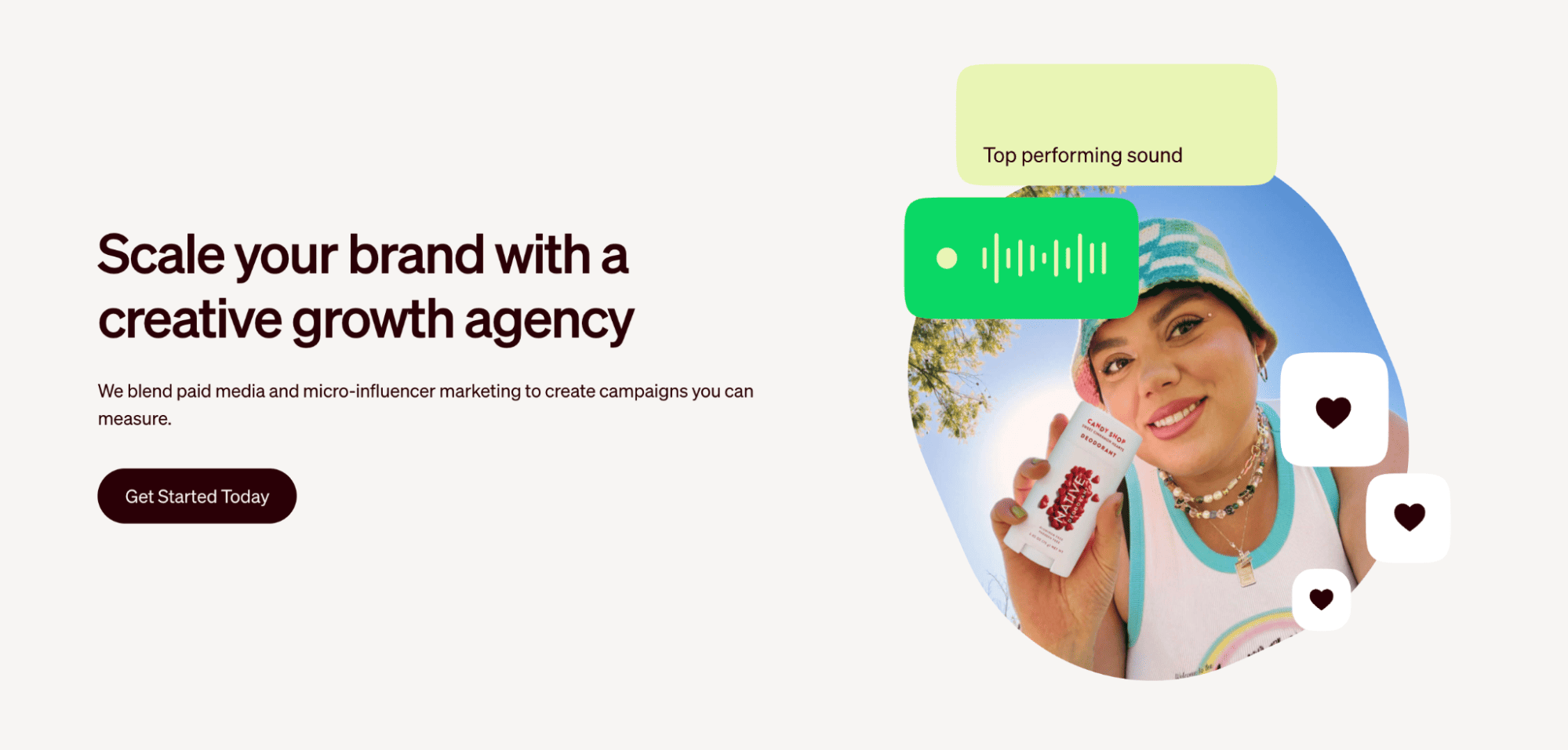
The way people buy has changed, and so has the role of creators in social media marketing. At inBeat, we’ve always believed that social content should be accountable to performance.
That’s why our model leverages creators, data, and paid media into one ecosystem. Every asset and every dollar spent feeds back into a continuous optimization loop built for performance.
Our approach gets results. Here are a few highlights:
AI helps us move faster, test smarter, and optimize with precision. At inBeat, we integrate AI-driven capabilities across our workflow, including:
These layers help clients reduce wasted spend, accelerate testing cycles, and gain clearer visibility into what drives conversions. We also increase your Google presence and drive more search traffic to your website.
We work with brands that thrive on authentic, creator-driven storytelling and performance, including:
Our core services help brands scale with consistent, high-performing creator content:
Merkle excels at solving a challenge many enterprise teams face: making large, scattered data systems work together. Their focus is on building connected customer experiences across complex tech stacks.
Merkle isn’t a traditional advertising agency. They sit closer to the data, CX, and technology side of marketing, working with large organizations to connect paid media, CRM, and customer experience across complex stacks. Advertising is part of what they do, but usually as one component of broader, long-term programs.
Their stack includes predictive analytics, personalization engines, cross-channel attribution and lifetime value modeling. These are all supported by in-house data science and strong first-party data infrastructure. In practice, this means AI is used to inform media strategy, targeting, and experience design, not to replace core advertising fundamentals.
Retail, finance, healthcare, technology, and B2B brands.
Merkle is a good fit for enterprise teams that need AI and paid media to work reliably across data, platforms, and regions. If you’re looking for fast creative iteration or ad-first innovation, they may feel heavy. If you need structure, scale, and governance, they’re strong.
SmartSites stands out for its execution-first approach. They use AI to make search and paid campaigns more efficient. As such, they’re folding it into workflows like keyword research, content optimization, and campaign automation.

They apply AI for insights, targeting, workflow automation, and campaign optimization.
Healthcare, B2B, eCommerce, retail, automotive, and professional services.
We appreciate their consistent delivery and practical use of AI across search and performance channels. However, don’t expect a very extended use of AI.
Ignite Visibility does strategy and measurable execution across search, paid channels, and lifecycle marketing. Their steady mix of SEO, paid media, email, creative, and CRO is supported by forecasting and analytics. As such, they help brands get discovered across search, social, and emerging AI-driven discovery channels.
Ignite Visibility approaches AI primarily as an applied capability rather than proprietary technology. They focus on generative AI education, generative engine optimization (GEO), and adapting SEO and content strategies for platforms like Google’s AI Overviews and LLM-based search experiences. AI is also used to support content workflows, customer data analysis, and campaign optimization. Plus, they can embed it into forecasting, competitor analysis, and automated reporting.
e-Commerce, retail, B2B, service businesses, and technology.
We like their balanced, practical approach, which supports long-term growth without unnecessary complexity. Ignite Visibility is a solid choice for teams that want practical guidance on how AI is changing search and content discovery, paired with hands-on performance execution. They’re less focused on building custom AI platforms, but effective for brands that need to adapt quickly to generative search without overhauling their existing marketing stack.
Jellyfish combines enterprise execution with hands-on digital training. They help teams operationalize AI across creative, media, and data workflows, which are essential for multi-market brands.

Their Swarovski “One Search” initiative drove 19% YoY growth while reducing paid media spend by 14%. This showed the impact of integrated AI and analytics.
Jellyfish treats generative AI as an operational layer, not just a feature. They use it to speed up analysis, reporting, content workflows, and social performance through tools like their Social Agents and cloud-enabled marketing infrastructure. Jellyfish uses AI to automate bidding, forecast performance, accelerate creative production, and unify data insights. However, while they apply AI to improve efficiency and decision-making across social, media, and content, they don’t use it to replace human strategy or creativity.
Enterprise, retail, travel, entertainment, and technology brands.
Jellyfish is well suited for brands that want global execution with consistent processes and AI-supported delivery. They’re strongest when scale, speed, and platform alignment matter more than bespoke creative experimentation.
Brainlabs treats marketing more like research. They embed AI into experimentation and real-world workflows. Their proprietary Cortex AI platform and data-first culture help teams refine targeting, automation, and creative through repeatable tests.

AI sits at the core of Brainlabs’ execution through their proprietary Cortex platform. Cortex is used to unify data sources, automate media decisions, surface real-time insights, and accelerate testing across channels like paid search, paid social, programmatic, retail media, and SEO. AI supports faster iteration and more precise optimization, but doesn’t replace human strategy.
eCommerce, retail, finance, technology, and B2B.
Brainlabs is a good fit for brands that want disciplined, test-driven media execution at scale. They stand out when experimentation, speed, and measurable impact matter more than brand storytelling or campaign-led creative.
Wpromote combines strategic thinking with integrated technology. Instead of treating each channel in isolation, they bring data, media, creative, and analytics together under a performance-first model they describe as “brandformance.”. Their Polaris platform unifies data and forecasts outcomes, helping teams plan across channels.

Wpromote uses AI-powered insights in planning, automation, and media optimization to show how channels influence one another. That helps teams move beyond channel-by-channel optimization and make budget decisions based on how performance actually compounds across the mix.
Finance, retail, education, technology, healthcare, and eCommerce.
We appreciate their focus on connecting data and strategy so performance insights lead to smarter growth. Their AI-supported approach works well for cross-channel optimization and full-funnel measurement. That said, their model is best suited for organizations ready to invest in integrated planning and experimentation; teams looking for lightweight, channel-specific execution may find the approach heavier than necessary.
Tinuiti applies AI and data to media channels and commerce-driven outcomes. Their proprietary tech like Bliss Point by Tinuiti blends with cross-channel strategy to align search, social, marketplaces, and retail media.
Tinuiti integrates AI into SEO innovation, predictive audience modeling, and forecasting so brands stay visible in complex commerce environments. Bliss Point applies machine learning to unify fragmented data, address signal loss, and reduce platform bias across channels. That way, your media teams access to insights while campaigns are still live
Retail, CPG, DTC, fashion, electronics, and other commerce-focused brands.
Their retail-first approach makes them well suited for brands dealing with omnichannel growth in various marketplaces. Bliss Point also works well if you want deeper measurement clarity without rebuilding your analytics stack. However, it works best when paired with teams ready to act on advanced insights in real time.
Disruptive Advertising is a performance-focused digital marketing agency centered on paid media, CRO, and revenue growth. In our opinion, their work is strongly execution-led, with an emphasis on search, paid social, and programmatic advertising rather than broad CX or brand transformation.
We also like that Disruptive Advertising focuses on revenue. They use AI in ways that support better decision-making across PPC, paid social, and CRO. For example, they use AI for automation, behavioral analytics, and even creative testing to refine what drives results.
They helped Crossover Symmetry grow monthly revenue by 158% and Standartpark increase Q4 revenue by 97%, adding $478K in sales.

Disruptive relies primarily on AI built into advertising and analytics platforms rather than proprietary AI systems. This includes algorithmic bidding, audience modeling, programmatic buying, and data-driven optimization within tools like Google Ads, social platforms, and marketing automation software. Their own content positions AI as a way to improve efficiency, targeting, and decision-making, with humans still setting strategy and success criteria.
eCommerce, SaaS, finance, B2B, and local services.
We appreciate that they apply AI through existing ad platforms with discipline and keep their focus on decisions that impact revenue. They’re less focused on building custom AI infrastructure or advanced measurement models, but effective when the goal is efficient execution and steady optimization rather than experimental or tech-heavy innovation.
NP Digital takes a holistic view of search and paid performance. They weave SEO, content, analytics, and media into a unified strategy that reflects how audiences discover brands today. They also leverage AI-informed search strategy and proprietary platforms to connect discovery with execution.
NP Digital applies AI primarily to search and discovery. This includes AI-informed SEO strategies, content optimization for LLM-driven search experiences, paid media automation, and advanced analytics. They are good at adapting search strategies to how users now discover information through platforms like Google, app stores, and generative AI interfaces. That means they put traditional keyword research on the backseat.
SaaS, eCommerce, healthcare, finance, and B2B brands globally.
We like their emphasis on connecting organic and paid strategies through data and AI. NP Digital is pretty good at AI-powered discovery. However, teams looking for heavy brand storytelling or experimental creative may find the approach more performance- and search-centric than expected.
SmartSites stands out for its execution-first approach. They use AI to make search and paid campaigns more efficient. As such, they’re folding it into workflows like keyword research, content optimization, and campaign automation.

They apply AI for insights, targeting, workflow automation, and campaign optimization.
Healthcare, B2B, eCommerce, retail, automotive, and professional services.
We appreciate their consistent delivery and practical use of AI across search and performance channels. However, don’t expect a very extended use of AI.
This list wasn’t built on surface-level claims. We focused on how these agencies actually use AI to deliver better marketing outcomes, which we advise you to also do when you’re shortlisting potential providers.
Here’s what we looked for:
In 2026, AI will be foundational to how high-performing marketing teams operate. Leading agencies will use it to speed up decision-making, connect data, and deliver more relevant customer experiences without sacrificing control.
For teams looking to put AI to work in a results-driven way, agencies like inBeat Agency show what’s possible.
Get in touch today and check out our free marketing toolkit for creator marketing, paid social, and organic social.
An AI-driven digital marketing agency uses artificial intelligence as a core part of its operations. AI informs targeting, content creation, optimization, analytics, and decision-making.
They can be. AI agencies may move faster, test more efficiently, and optimize campaigns in real time, leading to better ROI and clearer attribution.
Industries with large datasets and digital-first acquisition models, like eCommerce, SaaS, DTC, finance, healthcare, and B2B services, may benefit the most from AI marketing.
Look for clear explanations of how AI tools are used, examples of automated optimization or predictive modeling, and transparent reporting on how data drives decisions.